Full text available upon request
Blueprints of Invasion: Cyanotype Impressions of Post-Extraction Flora in Narva
In the aftermath of industrial extraction, landscapes often become silent witnesses to destruction, memory, and adaptation. Narva, Estonia offers a compelling case study of such a site. The region, deeply affected by oil shale mining, now hosts a resilient population of invasive and non-native plants. These plants have adapted to hostile, chemically disturbed soils and wastelands left by the mining industry. Their presence is both contested and vital, embodying the contradictions of ecological recovery and geopolitical unease. The core research of this project is situated within disturbed zones around Narva, where extraction scars the soil and industrial debris reshapes the terrain. Invasive and non-native plant species, often regarded as biological migrants, have taken root in the contaminated soils and derelict zones left behind by extraction. This project, Blueprints of Invasion, documents these species through the cyanotype process, framing them not only as ecological phenomena but also as metaphors for human displacement, particularly drawing from Anna Tsing’s notion of “contaminated diversity”, life that thrives in the aftermath of destruction.
Research questions:
- How have historical processes of extraction (specifically oil shale mining) shaped the ecological conditions that enable these plants to flourish?
- In what ways do these plants function as ecological first responders or informal agents of remediation in disturbed soils?
- How can cyanotype (a medium historically used in colonial botanical cataloguing) be recontextualized as a critical tool for ecological and political storytelling?
- How do the narratives around invasive species parallel those of displaced human populations, especially in politically complex border zones like Narva?
- Can a non-anthropocentric understanding of migration and displacement—viewing plants as ecological migrants—reshape our response to human migration?
Methodology: Cyanotype as Postcolonial Tool
Historically, cyanotype has been tied to imperial regimes of botanical classification and control. Anna Atkins’ Photographs of British Algae (1843) is often celebrated as a pioneering work of both photography and scientific documentation. Yet, it also exemplifies how photographic technologies were harnessed to organize and dominate the natural world as it is often used by the colonizer botanists. By reappropriating this technique to document plants labeled as invasive, Blueprints of Invasion challenges these colonial legacies. The process is no longer about fixing identity or cataloging differences; it becomes about honoring presence and acknowledging transformation. The blurry blue forms resist easy legibility, echoing the uncertain status of both migrant plants and people. As Ariella Azoulay (2019) argues, the act of photographing can be reimagined as a practice of "potential history"—a way of disrupting inherited narratives and imagining otherwise. Overall, cyanotype evokes the tension between scientific categorization and aesthetic interpretation. The medium becomes a tool not only for image-making but for critical reflection on the politics of visibility and survival. Ultimately, the cyanotype process is reflective of historical entanglements between science and coloniality—where botanical knowledge was often tied to imperial expansion and control.
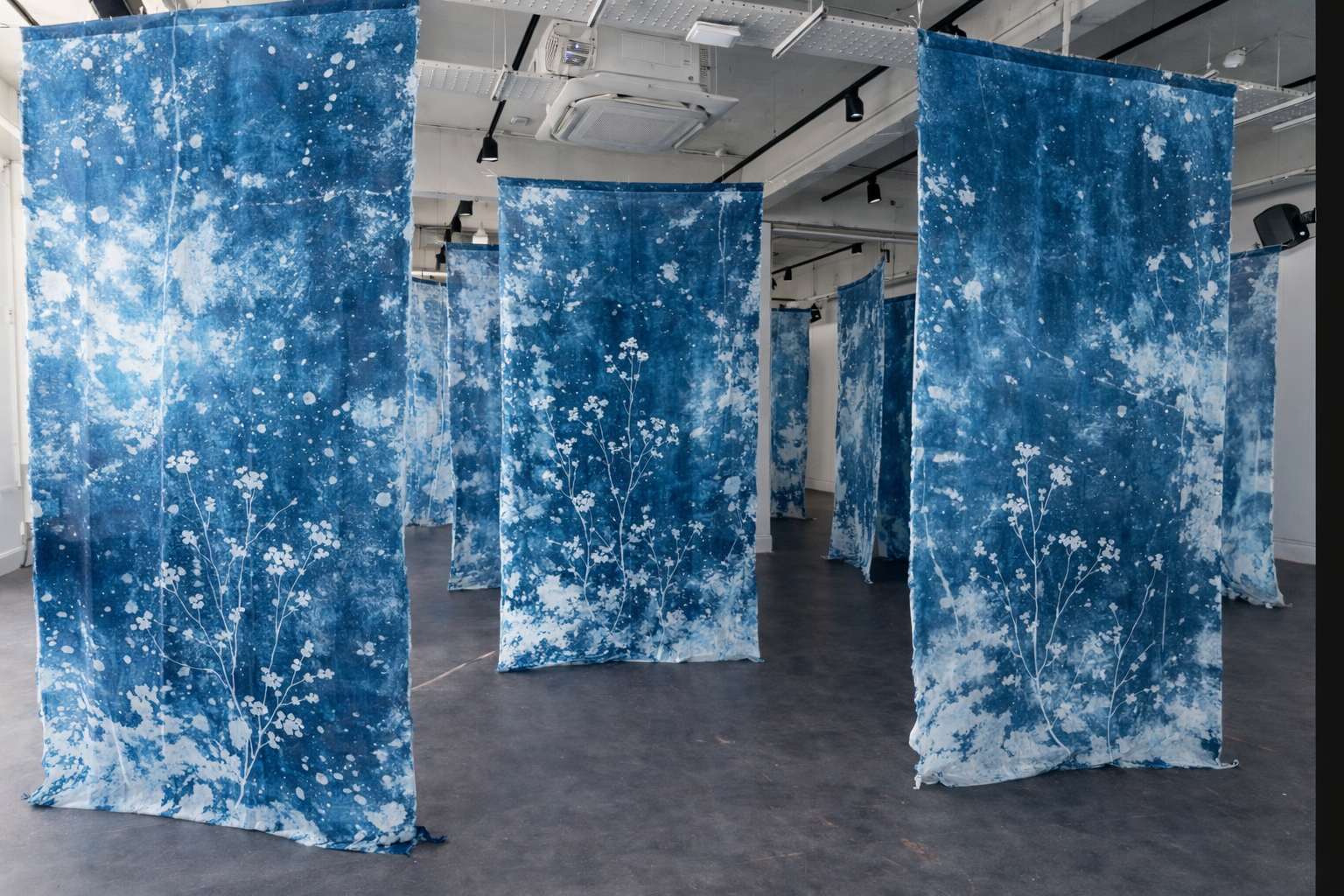
The artistic methodology centers on fieldwork in Narva's post-mining zones. Through repeated field visits to the Kukruse and Auvere ash mountain, forest and Sompa ghost towns, I collected and documented plant specimens identified as non-native or invasive by ecological classifications. Plant specimens identified as invasive or non-native, such as Reynoutria japonica (Japanese knotweed), Solidago canadensis (Canadian goldenrod), and Lupinus polyphyllus (garden lupine), were collected and documented using cyanotype. Sensitized papers were exposed using natural sunlight on-site, allowing environmental factors—light, wind, rain, humidity—to shape the final imprint.
In this project, cyanotype functions not only as a tool of image-making but also as a conceptual framework—producing no-so-perfect imprints of plants whose presence is both controversial and inevitable. These images function as ecological artefacts, and speculative blueprints of emerging landscapes. Reappropriating this method in a contemporary context invites critical reflection on the languages of purity, nativeness, and threat that continue to shape how we speak about both plants and people.
Displacement and the Rhetoric of Invasion
In the post-industrial landscapes of Narva, Estonia where oil shale mining once defined the socio-economic fabric, the land now hosts a different kind of occupant: invasive and non-native plant species. These species, thriving in the ecological voids left behind by extraction and abandonment, are often framed within narratives of disruption and displacement. Yet, they are also agents of resilience, capable of rooting into chemically scarred soils, stitching together fractured ecosystems.
The concept of invasion—whether ecological or geopolitical—is fraught with moral judgment and exclusionary logic. Invasive species are typically portrayed as ecological villains: aggressive, unnatural, and threatening to native purity. This mirrors the rhetoric surrounding displaced human populations, particularly in politically sensitive border zones like Narva. The language used to describe both groups—"alien," "unwanted," "threatening"—reveals deep anxieties about boundaries, purity, and control. As scholars such as Anna Tsing (2015) and Donna Haraway (2016) have noted, life in the ruins of capitalist modernity often requires uncomfortable alliances. Tsing’s concept of “contaminated diversity” acknowledges the unpredictable assemblages that emerge in disturbed landscapes. These assemblages, far from ideal or pristine, nonetheless offer possibilities for transformation and cohabitation. Invasive plants, like displaced people, adapt to the aftermath of violence, absolute transformation, remaking territory and narrative alike. In these plants, we encounter a visual and conceptual mirror to the lives of displaced people: uprooted, stigmatized, yet remarkably adaptive in hostile environments. Just as plants deemed “invasive” are defined by their movement across borders and their disruption of ecological order, so too are displaced human populations often perceived through the lens of threat, illegitimacy, or burden. These plants and people alike are subject to regimes of classification, containment, and exclusion. The language used to describe them (non-native, unwanted) reveals a deep-seated anxiety about purity and control, rooted in colonial, nationalist, and biopolitical ideologies.
Narva as a Site of Liminal Belonging Narva’s geopolitical position intensifies these themes. With a predominantly Russian-speaking population and a history of Soviet industrialization, the city exists in a state of cultural and political ambiguity. It is both inside and outside the national imaginary of Estonia. This liminality extends to its landscapes, where post-industrial ruins serve as habitats for equally ambiguous flora.
The project locates these ruins not as dead zones, but as stages of regeneration. In this sense, cyanotype prints become visual testaments to survival amidst abandonment. The plants are not passive subjects but active agents of remediation, stabilizing soils and creating micro-habitats. Their presence demands a rethinking of what constitutes ecological value and belonging.
Credits:
Azoulay, Ariella. Potential History: Unlearning Imperialism. London: Verso, 2019.
Haraway, Donna. Staying with the Trouble: Making Kin in the Chthulucene. Durham: Duke University Press, 2016.
Tsing, Anna. Contaminated Diversity in “Slow Disturbance”: Potential Collaborators for a Liveable Earth. Princeton: Princeton University Press, 2015.
Chew, Matthew K., and Manfred D. Laubichler. "Natural Enemies—Metaphor or Misconception?" Science 301, no. 5629 (2003): 52–53.
Cronon, William. "The Trouble with Wilderness: Or, Getting Back to the Wrong Nature." Environmental History 1, no. 1 (1996): 7–28.
Robbins, Paul. Political Ecology: A Critical Introduction. 2nd ed. Chichester: Wiley-Blackwell, 2012.